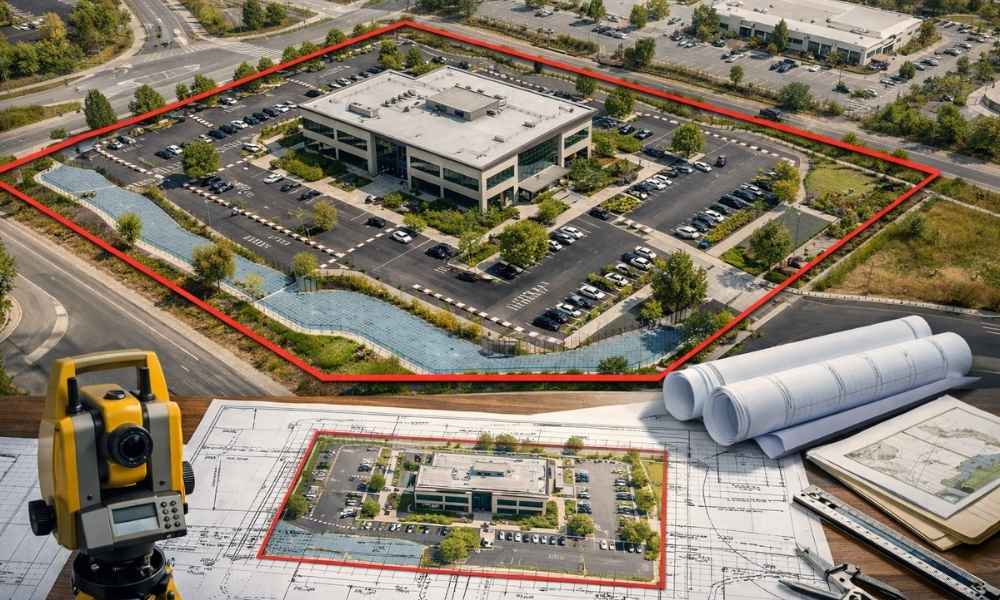
If you are buying or developing commercial property, an ALTA survey is one of the most important documents you will need. It protects your investment. It protects your lender. And it can prevent costly surprises after closing.
This article breaks down what an ALTA survey is, what it covers, when you need one, and how it compares to other survey types.
What Is an ALTA Survey and Why Is It Used in Commercial Real Estate?
An ALTA survey is a detailed land survey that meets national standards set by the American Land Title Association (ALTA) and the National Society of Professional Surveyors (NSPS). The most recent standards were updated in 2021.
It is one of the most thorough survey types available for commercial real estate.
Lenders, title companies, and buyers all use ALTA surveys. They want to know exactly what they are buying or lending against. A standard property deed does not always tell the full story. Easements may not be visible. Encroachments may not be recorded. An ALTA survey surfaces all of it.
In Vermont, commercial transactions involving institutional lenders almost always require an ALTA survey before closing. Title insurance underwriters also rely on it to issue extended coverage policies.
Who requests it:
- Commercial buyers and investors
- Mortgage lenders and banks
- Title insurance companies
- Attorneys managing commercial closings
The surveyor, title company, lender, and buyer all work together during the process. The surveyor reviews title documents, visits the site, and produces a map that reflects the real conditions on the ground.
What Information Does an ALTA Survey Include?
An ALTA survey goes well beyond property lines. It documents everything that could affect how you own or use the land.
Standard items included:
- Property boundaries and dimensions
- Easements and rights-of-way, both recorded and visible
- Encroachments from neighboring properties or improvements
- Buildings, structures, and other improvements on the site
- Access points and road frontage
- Setback lines and building restriction lines
- Parking areas, driveways, and utility infrastructure
- Adjoining property owners and street names
The 2021 ALTA/NSPS standards allow clients to request additional optional items through what is called “Table A.” These include floodplain information, zoning classifications, underground utilities, and more.
Vermont has specific geographic and environmental features that can affect survey results. Wetland boundaries, steep slopes, and private road access are common issues that show up in ALTA surveys. A licensed land surveyor will know how to identify and document these accurately.
When Is an ALTA Survey Required?
Not every property transaction requires an ALTA survey. But most commercial deals do.
Common situations where one is required:
- Purchase of commercial or investment property
- Refinancing a commercial mortgage
- New commercial construction or major renovation
- Obtaining title insurance with extended coverage
- Lease agreements for large commercial or industrial spaces
Lender requirements vary. Some lenders require full ALTA compliance. Others may accept a boundary survey with title endorsements. Always confirm with your lender and title company early in the transaction.
In Vermont, rural commercial properties often come with access challenges, shared driveways, or historic easements that only show up in an ALTA survey. Getting one early saves time and reduces the risk of deal delays.
How Does an ALTA Survey Differ From Other Types of Land Surveys?
There are several types of land surveys used. Each serves a different purpose.
Boundary Survey
A boundary survey identifies and marks property corners and lines. It is useful for residential lots and simple land transfers. It does not include the level of detail required for commercial transactions or title insurance.
Topographic Survey
A topographic survey maps the shape of the land. It shows elevation changes, drainage features, and natural contours. It is used for site planning and engineering. It does not address title or ownership issues.
Construction Survey
A construction survey is used during building projects. It places stakes and marks for grading, foundations, and utilities. It is project-specific and not used for property transfers.
ALTA Survey
An ALTA survey combines elements of a boundary survey with a detailed review of title documents. It meets standardized national requirements. It is designed specifically for commercial real estate transactions where lenders and title companies need certainty.
No other survey type matches the scope and standardization of an ALTA survey for commercial deals.
What to Expect During the ALTA Survey Process
The ALTA survey process has several steps. Knowing what to expect helps you plan your timeline and avoid delays.
Step 1: Title Document Review
The surveyor reviews the deed, prior surveys, easements, rights-of-way, and other documents related to the property. This can take several days depending on the complexity of the title history.
Step 2: Fieldwork
The survey crew visits the site. They locate boundary markers, measure the property, and document all visible features. In Vermont, fieldwork can be affected by snow, terrain, or vegetation, especially on larger parcels.
Step 3: Coordination With the Title Company
The surveyor works with the title company to cross-check recorded easements and documents against what is found in the field. Any discrepancies are noted and resolved.
Step 4: Drafting the Final Survey
The surveyor prepares a detailed map and certification. It is signed and stamped by a licensed Vermont land surveyor. The final document is delivered to the buyer, lender, and title company.
Typical timeline:
Most ALTA surveys take two to four weeks. Complex properties, rural parcels, or sites with title issues can take longer. It is best to order the survey as early as possible in the transaction process.
Factors that can slow things down include incomplete title documents, unmarked or missing property corners, adverse weather, and high demand periods during the spring and summer real estate season.